
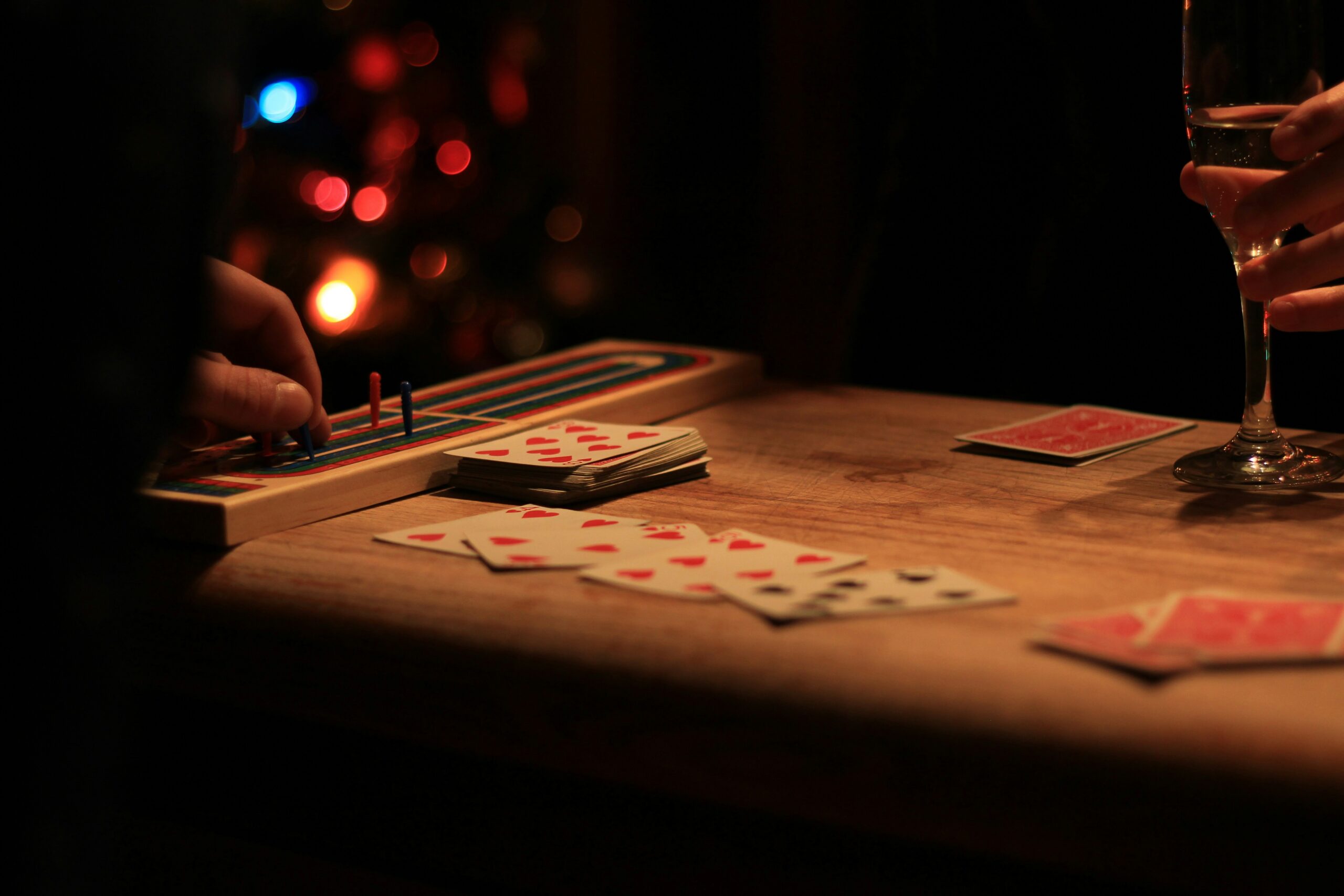
New Year Cribbage
Added By:
 Herald
Herald

 Upload New Main Image
-

Difficulty
Easy, Moderate
-

Physical Effort
Low
-

Exp Required
None
-

Price Range
$0, $.01 to $10, $10 to $50
-
Uniqueness
3
-
Age Range
Child, Pre-teen, Teen, Adult, Senior
-
Min Number
No data available
-
Complexity
Simple, Moderate
Test – Cribbage, or crib, is a card game, traditionally for two players, that involves playing and grouping cards in combinations which gain points. It can be adapted for three or four players.
The game has relatively few rules yet many subtleties, which accounts for its ongoing appeal and popularity. Tactical play varies, depending on which cards one’s opponent has played, how many cards in the remaining pack will help the hand one holds, and what one’s position on the board is. A game may be decided by a single point, and the edge often goes to an experienced player who utilizes strategy, including calculating odds and making decisions based on the relative positions of players on the board.
Rules
Main article: Rules of cribbage
A game of cribbage being played
Play proceeds through a succession of “hands”, each hand consisting of a “deal”, “the play” and “the show”. At any time during any of these stages, if a player reaches the target score (usually 121), play ends immediately with that player being the winner of the game. This can even happen during the deal, since the dealer scores if a jack is cut as the starter.
Deal
The players cut for first deal, and the person who cuts the lowest card deals. The dealer shuffles and deals five or six cards to each player, depending on the number of players. For two players, each is dealt six cards; for three or four players, each is dealt five cards. In the case of three players, a single card is dealt face down in the centre of the table to start the crib. Once the cards have been dealt, each player chooses four cards to retain, then discards the other one or two face-down to form the “crib” (also called the box), which will be used later by the dealer.
At this point, each player’s hand and the crib will contain exactly four cards. The player on the dealer’s left or, in a two-player game, the pone, cuts the remaining pack. The dealer reveals the top card of the lower half, called the “starter card” or “cut”, and places it face up on top of the reunited pack. If this card is a jack, the dealer scores two points for “his heels” or “his nibs”.
Play
Cribbage being played with a travel-sized scoring board
Starting with the player on the dealer’s left, the players each, in turn, lay one card face up on the table in front of them, stating the count—that is, the cumulative value of the cards that have been laid (for example, the first player lays a five and says “five”, the next lays a six and says “eleven”, and so on)—without the count going above 31. Face cards (kings, queens, and jacks) count as 10. The cards are not laid in the centre of the table as, at the end of the “play”, each player needs to pick up the cards they have laid.
Players score points during the play as follows:
15 – For causing the count to reach exactly 15 a player scores two points, then play continues.
Pair – Completing a pair (two of a kind) scores two points.
Three of a kind is the same as three different pairs, or 6 points.
Four of a kind is 6 different pairs, or 12 points.
A run of three or more cards (consecutively played, but not necessarily in order) scores the number of cards in the run.
If a player cannot play without causing the count to exceed 31, they call “Go”. Continuing with the player on their left, the other players continue the play until no one can play without the count exceeding 31. A player is obliged to play a card unless there is no card in their hand that can be played without the count exceeding 31 (one cannot voluntarily pass). Once 31 is reached or no one is able to play, the player who played the last card scores one point if the count is still under 31 and two if it is exactly 31. The count is then reset to zero and those players with cards remaining in their hands repeat the process starting with the player to the left of the player who played the last card. When all players have played all of their cards the game proceeds to the “show”.
Players choose the order in which to lay their cards in order to maximize their scores; experienced players refer to this as either good or poor “pegging” or “pegsmanship”. If one player reaches the target (usually 61 or 121), the game ends immediately and that player wins. When the scores are level during a game, the players’ pegs will be side by side, and it is thought that this gave rise to the phrase “level pegging”.
Show
Once the play is complete, each player in turn, starting with the player on the left of the dealer, displays their own hand on the table and scores points based on its content in conjunction with the starter card. Points are scored for:
Combinations of any number of cards totaling fifteen
Runs
Pairs (Multiple pairs are scored pair by pair but may be referred to as three or four of a kind.)
Four-card flush (All four cards in the hand of the same suit score four points.)
Five-card flush (All four cards in the hand of the same suit as the starter card score five points. A flush in the crib must be a five-card flush according to the official rules of the ACC.)
Having a jack of the same suit as the starter card (“one for his nob [or nobs or nibs]”, sometimes called the “right” jack)
The dealer scores their hand last and then turns the cards in the crib face up. These cards are then scored by the dealer as an additional hand, also in conjunction with the starter card. Unlike the dealer’s own hand, the crib cannot score a four-card flush, but it can score a five-card flush with the starter.
All scores from 0 to 29 are possible, with the exception of 19, 25, 26 and 27.[18] Players may refer colloquially to a hand scoring zero points as a “nineteen hand”.
Muggins
Muggins is a commonly used but optional rule, which must be announced before game play begins and exact rules worked out. If a player fails to claim their full score on any turn, the opponent may call out “Muggins” and peg any points overlooked by the player.
Match
A match (much like tennis) consists of more than one game, often an odd number. The match points are scored on the cribbage board using the holes reserved for match points. On a spiral board, these are often at the bottom of the board in a line with 5 or 7 holes. On a conventional board, they are often in the middle of the board or at the top or bottom.
In a two-player game of cribbage, a player scores one match point for winning a game. Their opponent will start as dealer in the next game. If a player lurches (British) or skunks (US) their opponent (reaches 121 points before their opponent scores 91 points), that player wins two match points for that game. If a player double skunks their opponent (reaches 121 points before their opponent reaches 61), they score three or four match points for the game, depending on local convention.[20] If a player triple skunks their opponent (reaches 121 points before their opponent reaches 31 points), they automatically win the match. Double and triple skunks are not included in the official rules of cribbage play and are optional. There are several different formats for scoring match points.
 Add Before / After
Add videos of this activity
Videos help others preview the activity. Upload videos to help inspire others
Upload video
Add images of this activity
Images help others preview the activity. Upload images to help inspire others
Upload image

Cribbage Game
Herald
Cribbage added by:
Last Edited by:

Nathan
Hey! I am the Founder of ExploreLife.Today
Edit Activity
Help improve this activity by making an edit, adding details or images and videos
Create New Activity
Become an ExploreLife.Today contributor! Help inspire people from around the world discover an activity to do.
Become A Contributor- Standard Deck
- Games
- Board
- Card
- Moods:
- Feeling Calm
- Cheer Up
- Be Cheerful
- Spread Cheer
- Calm
- Cheerful
- Chillin
New Year Cribbage
Added By:
Herald
Herald
Upload New Main Image
-
Difficulty
Easy, Moderate
-
Physical Effort
Low
-
Exp Required
None
-
Price Range
$0, $.01 to $10, $10 to $50
-
Uniqueness
3
-
Age Range
Child, Pre-teen, Teen, Adult, Senior
-
Min Number
No data available
-
Complexity
Simple, Moderate
Test – Cribbage, or crib, is a card game, traditionally for two players, that involves playing and grouping cards in combinations which gain points. It can be adapted for three or four players.
The game has relatively few rules yet many subtleties, which accounts for its ongoing appeal and popularity. Tactical play varies, depending on which cards one’s opponent has played, how many cards in the remaining pack will help the hand one holds, and what one’s position on the board is. A game may be decided by a single point, and the edge often goes to an experienced player who utilizes strategy, including calculating odds and making decisions based on the relative positions of players on the board.
Rules
Main article: Rules of cribbage
A game of cribbage being played
Play proceeds through a succession of “hands”, each hand consisting of a “deal”, “the play” and “the show”. At any time during any of these stages, if a player reaches the target score (usually 121), play ends immediately with that player being the winner of the game. This can even happen during the deal, since the dealer scores if a jack is cut as the starter.
Deal
The players cut for first deal, and the person who cuts the lowest card deals. The dealer shuffles and deals five or six cards to each player, depending on the number of players. For two players, each is dealt six cards; for three or four players, each is dealt five cards. In the case of three players, a single card is dealt face down in the centre of the table to start the crib. Once the cards have been dealt, each player chooses four cards to retain, then discards the other one or two face-down to form the “crib” (also called the box), which will be used later by the dealer.
At this point, each player’s hand and the crib will contain exactly four cards. The player on the dealer’s left or, in a two-player game, the pone, cuts the remaining pack. The dealer reveals the top card of the lower half, called the “starter card” or “cut”, and places it face up on top of the reunited pack. If this card is a jack, the dealer scores two points for “his heels” or “his nibs”.
Play
Cribbage being played with a travel-sized scoring board
Starting with the player on the dealer’s left, the players each, in turn, lay one card face up on the table in front of them, stating the count—that is, the cumulative value of the cards that have been laid (for example, the first player lays a five and says “five”, the next lays a six and says “eleven”, and so on)—without the count going above 31. Face cards (kings, queens, and jacks) count as 10. The cards are not laid in the centre of the table as, at the end of the “play”, each player needs to pick up the cards they have laid.
Players score points during the play as follows:
15 – For causing the count to reach exactly 15 a player scores two points, then play continues.
Pair – Completing a pair (two of a kind) scores two points.
Three of a kind is the same as three different pairs, or 6 points.
Four of a kind is 6 different pairs, or 12 points.
A run of three or more cards (consecutively played, but not necessarily in order) scores the number of cards in the run.
If a player cannot play without causing the count to exceed 31, they call “Go”. Continuing with the player on their left, the other players continue the play until no one can play without the count exceeding 31. A player is obliged to play a card unless there is no card in their hand that can be played without the count exceeding 31 (one cannot voluntarily pass). Once 31 is reached or no one is able to play, the player who played the last card scores one point if the count is still under 31 and two if it is exactly 31. The count is then reset to zero and those players with cards remaining in their hands repeat the process starting with the player to the left of the player who played the last card. When all players have played all of their cards the game proceeds to the “show”.
Players choose the order in which to lay their cards in order to maximize their scores; experienced players refer to this as either good or poor “pegging” or “pegsmanship”. If one player reaches the target (usually 61 or 121), the game ends immediately and that player wins. When the scores are level during a game, the players’ pegs will be side by side, and it is thought that this gave rise to the phrase “level pegging”.
Show
Once the play is complete, each player in turn, starting with the player on the left of the dealer, displays their own hand on the table and scores points based on its content in conjunction with the starter card. Points are scored for:
Combinations of any number of cards totaling fifteen
Runs
Pairs (Multiple pairs are scored pair by pair but may be referred to as three or four of a kind.)
Four-card flush (All four cards in the hand of the same suit score four points.)
Five-card flush (All four cards in the hand of the same suit as the starter card score five points. A flush in the crib must be a five-card flush according to the official rules of the ACC.)
Having a jack of the same suit as the starter card (“one for his nob [or nobs or nibs]”, sometimes called the “right” jack)
The dealer scores their hand last and then turns the cards in the crib face up. These cards are then scored by the dealer as an additional hand, also in conjunction with the starter card. Unlike the dealer’s own hand, the crib cannot score a four-card flush, but it can score a five-card flush with the starter.
All scores from 0 to 29 are possible, with the exception of 19, 25, 26 and 27.[18] Players may refer colloquially to a hand scoring zero points as a “nineteen hand”.
Muggins
Muggins is a commonly used but optional rule, which must be announced before game play begins and exact rules worked out. If a player fails to claim their full score on any turn, the opponent may call out “Muggins” and peg any points overlooked by the player.
Match
A match (much like tennis) consists of more than one game, often an odd number. The match points are scored on the cribbage board using the holes reserved for match points. On a spiral board, these are often at the bottom of the board in a line with 5 or 7 holes. On a conventional board, they are often in the middle of the board or at the top or bottom.
In a two-player game of cribbage, a player scores one match point for winning a game. Their opponent will start as dealer in the next game. If a player lurches (British) or skunks (US) their opponent (reaches 121 points before their opponent scores 91 points), that player wins two match points for that game. If a player double skunks their opponent (reaches 121 points before their opponent reaches 61), they score three or four match points for the game, depending on local convention.[20] If a player triple skunks their opponent (reaches 121 points before their opponent reaches 31 points), they automatically win the match. Double and triple skunks are not included in the official rules of cribbage play and are optional. There are several different formats for scoring match points.
Add videos of this activity
Videos help others preview the activity. Upload videos to help inspire others
Upload video
Add images of this activity
Images help others preview the activity. images videos to help inspire others
Upload image
Cribbage Game
Added By:
Herald
Herald
- Standard Deck
- Games
- Board
- Card
- Moods:
- Feeling Calm
- Cheer Up
- Be Cheerful
- Spread Cheer
- Calm
- Cheerful
- Chillin
Cribbage added by:
Last Edited by:
Nathan
Hey! I am the Founder of ExploreLife.Today
Edit Activity
Help improve this activity by making an edit, adding details or images and videos
Create New Activity
Become an ExploreLife.Today contributor! Help inspire people from around the world discover an activity to do.
Become A ContributorAdditional Details:

Price
$0.00 - $30.00

Time of the day
24 Hours

Duration
15 to 45 hours

Date Start
Date End

Season
All

Hours
- MON: -
- TUE: -
- WED: -
- THU: -
- FRI: -
- SAT: -
- SUN: -

Children
YES

Family
YES

Adults
YES

Indoor
YES

Outdoor
YES

At Home
YES
Add Resources
Add the resources & materials that people will need for this activity
Add a Resource
Cards (Standard Deck)
Standard deck of playing cards. Contains 52 cards + 2 jokers for optional use.
Add Optional Resources
Add resources & materials that are not required but can help improve the enjoyment of this activity
Sources and Attribution
Add sources for information relating to this activity
 Add a Source